
Is 2009 the year of Linux malware?
It is common knowledge that Linux users needn't worry about viruses because users don't run as root. I've never understood the reasoning behind this. Here are a few of the malicious things that a program can do without being root on Ubuntu 8.10:
Once malware has its grubby code all over your home folder, you are one fake dialog box away from giving it complete control over your system:
If you have ever run a program or script that wasn't included in your distribution, then you could have been infected with malware. (You weren't.)
Ubuntu in particular must be very enticing for malware writers, because:
Is 2009 the year of the linux desktop malware? How long until we see headlines like, "Researchers find massive botnet based on linux 2.30"?
Add an entry to .config/autostart
Change a line in .mozilla/firefox/*/prefs.js
Add a file to .local/share/applications
Putting them in .gnome2/system32 seems somehow appropriate
Just pick a port above 1024, and update the firewall with uPnp
put it in .mozilla/firefox/*/extensions/
call it "Ubuntu System Integration Plugin Helper"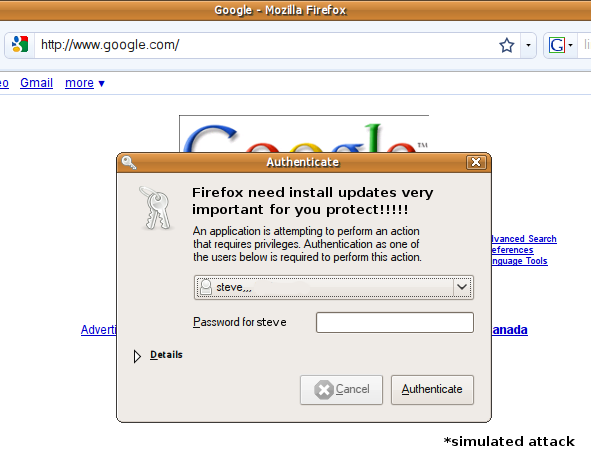
If you are interested in more examples, The Malware Project (PDF) is a great read that takes you step by step through an actual social engineering experiment with users. The results will surprise you.
top, ps, and System Monitor with exact clones that neglect to display your processes. This is much easier than hacking up the Windows Task Manager internal memory. Or just do everything in kernel mode for ultimate captcha cracking, DDOS power.
Further Reading
Comments