
How to Run a Fellowship Program Into the Ground (and get 18M impressions in the process)
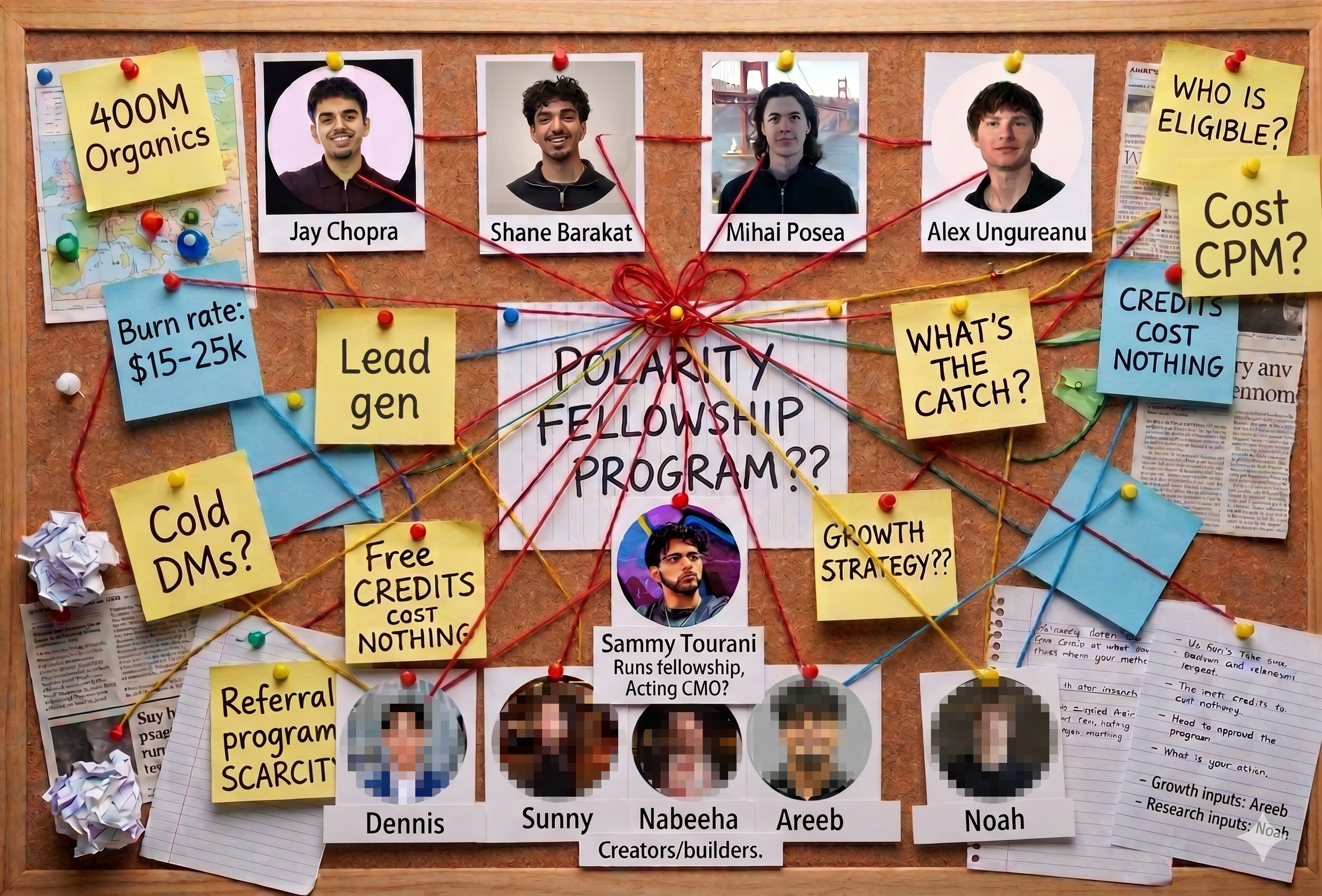
If you spent any time on tech LinkedIn in the spring of 2026, you probably saw them. They were everywhere. A highly coordinated swarm of 20-something engineers posting about a little-known Waterloo AI startup called Polarity.
By the time the fellowship wrapped, Polarity had generated over 18 million organic impressions across LinkedIn, X, and Instagram, flooded their pipeline with demo calls from enterprise engineering leaders, and effectively monopolized the attention of the Canadian tech corridor—right up until the entire movement spectacularly derailed.
Early rumors and hype posts claimed the cohort hit 400 million combined views. The final, confirmed number from the program's own architect is 18 million—more than most Series B companies get from their entire annual marketing budget.
If you were to buy eighteen million highly targeted impressions on LinkedIn's B2B ad platform—where 2026 tech/SaaS CPMs regularly float between $35 and $70—you'd be facing an invoice for roughly $630,000 to $1.26 million.
I gathered this information from personal interviews, and analyzing public posts. Nobody would spill the beans on the financials, but I suspect Polarity did it for about $8,000 in actual cash outlay, or on that order of magnitude.
Here is exactly how a startup operating on a lean $250,000 seed round engineered one of the most effective, asymmetrical B2B growth hacks of the year—and why giving 25 college students the keys to your enterprise brand is playing with fire.
The Architect and the Anti-Creator
The campaign began in mid-March when Jay Chopra, Polarity's Co-Founder and COO, posted a simple announcement: "This spring, I'm bringing together a small group of students." Within 72 hours, they had over 250 applications.
Then came Sammy Tourani.
Tourani joined Polarity as Head of Growth specifically to run the program. He didn't invent the "student fellowship" model from scratch—he internalized it while participating in similar programs at Boardy, Speechify, and Chatbase. Tourani is a bit of an anomaly. Before turning 21, he had participated in 11 hackathons, secured a $5,000 incubator grant, obtained security clearance to work with nuclear reactors, and scored an invite to YC's exclusive AI Summit.
His kickoff announcement poured gasoline on the fire: "I'm joining Polarity to run one of the most hyped fellowships in all of Canada. Applications close in 48 hours."
They ultimately received over 800 applications. But Polarity wasn't looking for influencers.
"We didn't hire content creators. We hired builders," Tourani explains. "They are currently working at Microsoft, Shopify, Tesla—going to New York or San Francisco, everywhere."
This was the purported secret to the campaign's success. Polarity builds Paragon, an autonomous "AI QA Engineer" that reviews pull requests and writes end-to-end tests. If you want a VP of Engineering to buy your highly technical DevTool, you can't have lifestyle influencers pitching it. You need credible engineers—people who understand PRs, technical debt, and deployment pipelines.
By selecting 25 builders with an average age of 21, Polarity seemingly secured the perfect messengers: young, highly technical, and hungry for a public platform.
Manufactured Scarcity
The fellowship itself became a recursive marketing flywheel. In a stroke of architectural genius, Polarity only selected half the cohort in the first phase. They then weaponized scarcity.
Each of the initial fellows was given exactly one referral slot to bypass the queue and send a candidate directly to the final interview round. This created a cascading viral loop across the platform:
- A fellow posts: "I got in, and I have one referral—pitch me why you deserve it."
- Dozens of highly qualified applicants comment with their life stories and GitHub links.
- The post goes algorithmic supernova due to the dense, high-quality comment engagement.
- More people discover Polarity, apply, and DM the fellows.
- The cycle repeats across 25 individual accounts.
Time after time, the highest-engaging posts in the program weren't about the software—they were about the program itself. Dennis Chen, a 20-year-old fellow, got 97 comments on his referral post alone. The FOMO was palpable.
And eventually, it would be the program's undoing.
The Results
Before the collapse, the program was delivering real, measurable outcomes that most startup marketing teams can only dream of.
The fellowship's hackathon and events drew over 1,000 signups. Partnerships materialized with Google, Microsoft, Clover Labs, NationGraph, GitCloud, SOON, Creatin, and top YC startups. C-suites at Lyft, Airbnb, Meta, and massive Series B/C companies reached out directly—not to complain about a LinkedIn post, but to book demos.
Fellows themselves walked away with jobs, opportunities, and a network that most engineers spend a decade building. And by all accounts, the 25 members of the cohort genuinely became close friends—a tight-knit group forged through months of collaborating, posting, and navigating the chaos together.
The program worked. That's what makes the next part so instructive.
Barter Economics: How to Spend $8,000 to get $630,000+ of Value
Information on the exact budget is closely guarded, but analyzing the program's structure reveals a masterclass in startup "barter economics." Nobody was getting rich off flat stipends. Instead, Polarity replaced cash with network effects, equity, and zero-marginal-cost software.
- Instead of burning their $250k seed round on LinkedIn Ads, they spent it on community and variable-cost incentives:
- Performance-Based Pay: Fellows weren't paid flat rates. They were paid CPM for post impressions and referral payouts for signups they drove. If a post flopped, it cost Polarity nothing. If it went viral, Polarity paid a highly discounted creator CPM rather than LinkedIn's exorbitant B2B ad rates.
- Infinite-Margin Perks: Each fellow received 100 Paragon credits a month (a $150 value). For Polarity, the marginal cost of these seats was zero.
- Community Over Venues: Instead of renting expensive event spaces, they leveraged their network. They hosted a hotpot dinner at a local hacker house, shot content at a student cafe, and took the cohort to a Blue Jays game. There was also a highly publicized hackathon.
In return, the fellows received the ultimate currency for a 21-year-old builder: prestige. They gave themselves titles like "AI QA Engineer," and through the natural engagement pod, exploded their personal brands.
"Their brand is our brand, our brand is their brand," Tourani noted.
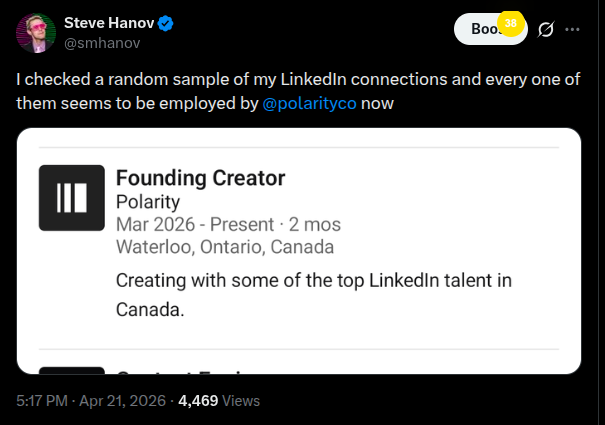
How the mask slipped
That "your brand is our brand" part gets messy real quick. For six weeks, posts seemed to have coordinated messaging. The fellows were posting about Polarity.
But after getting a taste of how being a growth leader works, they started to learn from eachother, posting not only Polarity puff pieces, but intermixing it with identity-driven content -- documenting their daily struggles as students as a quick way to gain impressions.
In late May, just a week before the fellowship was scheduled to end, that led to problems.
It started when one of the fellows published a LinkedIn post declaring that he and another fellow were "about to be sleeping on the streets" in San Francisco, including a realistic AI generated photo, a depiction of homelessness.
It had no link to Polarity, but this fellow was highly associated with the brand, as one of the most active fellows, and with the job position prominently displayed on his Linkin.
Members of the community were quick to call him out for using a social crisis to generate impressions. The post was eventually deleted, but the damage was done. The student community's simmering annoyance with the inescapable Polarity cohort boiled over.
Accusations of "Growth LARPing"
Consider the perspectives of everyone outside the program. One student told me: "A lot of people are part of [it], but it is an insulated community, and it seems to be hard to become part of it unless you network with specific people."
The exclusivity, the feeling of being left out, fostered ill-will that was bolstered every time someone mentioned Polarity. The mis-step unleashed a torrent of pent up critisms.
Over the next week, the r/uwaterloo subreddit exploded with over a dozen threads dismantling the program. The community didn't just attack the tone-deaf post; they attacked the entire premise of the fellowship.
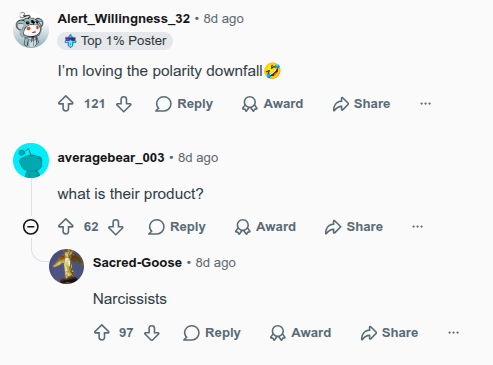
Critics called it "Growth LARPing". They accused the fellows of operating a massive "circle jerk" of "AI-generated striver slop"..
Very little can be verified; on this particular subreddit, shitposting is common, and many of the posts purporting to be Tourani or fellowship members making tone-deaf statements are likely fakes. But it still highlights how the constant barrage of elitism affected the people in the close-knit community.
What matters
"I know that the secrets don't matter," Tourani told me before the fallout. "It's all about the execution of the person running the program and their ability to turn it into a real family, a real movement."
That line hits differently now. Because in a sense, he was right. The program did become a real movement. The fellows did become a family. The execution was undeniably brilliant. And it still blew up.
It is tempting to look at Polarity's playbook, copy the CPM structure, and assume you'll easily generate 18 million B2B views for pennies. The unit economics of student barter-marketing are undeniably brilliant. The insights of spending on community instead of ads are valuable.
But Polarity is also a cautionary tale.
You can manufacture scarcity. You can buy impressions in exchange for amplifying creators. You can even generate enough noise to briefly monopolize an entire tech ecosystem. But if you lose control of your messaging, if you make your cohort too exclusive, you are one bad LinkedIn post away from the whole thing unraveling.
Steve Hanov has been coding since age 8, worked at Microsoft, BlackBerry, founded websequencediagrams.com and eh-trade.ca. This blog has been featured on the front page of HackerNews dozens of times. Follow him on LinkedIn as he takes on the biggest challenge a technical founder can tackle: GTM/Distribution.
Comments